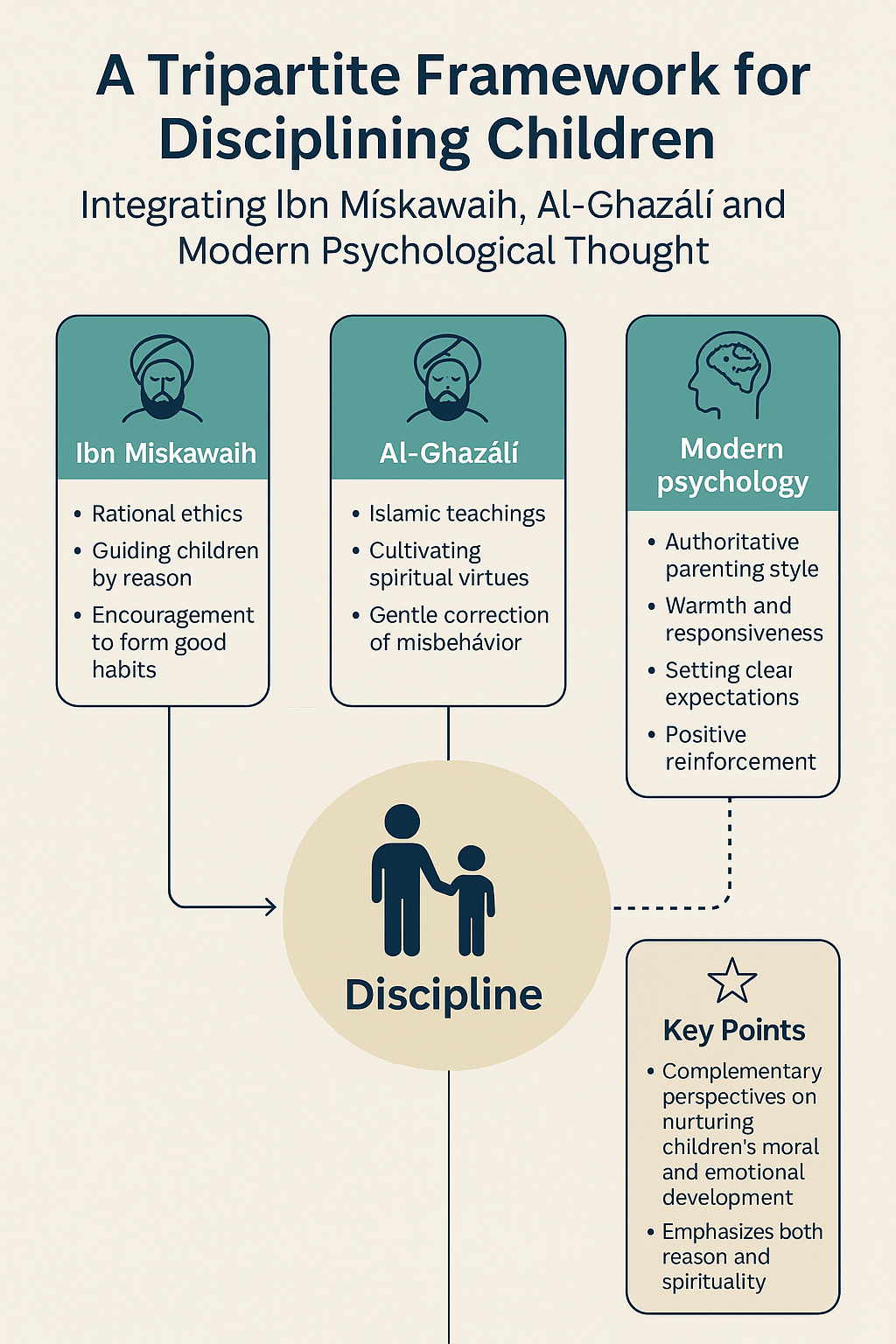
A Tripartite Framework for Disciplining Children: Integrating Ibn Miskawaih, Al-Ghazālī and Modern Psychological Thought
DOI:
https://doi.org/10.64984/ijcd.2.1.2025.04Keywords:
child-psychology, discipline, authoritative parenting, habit formation, gentle parenting, emotional regulationAbstract
In contemporary context of ever-increasing concerns like mental-health and moral confusion regarding how to upbring children; it is rather becoming difficult to provide a single solution. This is probably because of globalization, rapid change in educational systems, technological and digital era; new challenges are being faced by the millennials parents and mentors that were never faced prior to Gen Z, Gen. Alpha and Gen. Beta. In spite of several ethical debates on parenting style, I believe that a single approach won’t provide a feasible solution, so in this paper we are going to use tripartite framework. By integrating the rational ethics of Ibn Miskawaih, spiritual guidance of Al-Ghazālī and modern psychological theories we can develop a balanced model for disciplining children of both current and future generations. A model that respects children dignity, nurture their character; and prepares them for success in both this world and hereafter (i.e. meeting both its worldly and spiritual needs). The current paper is divided into 5 sections: (1) introduction to importance of disciplining children techniques for present and future generations in changing times; (2) and (3) shall focus on Ibn Miskawaih and Al-Ghazālī perspectives on children upbringing; section (4) will focus on modern psychological theories to discipline children and raise them to be responsible moral individuals. Lastly, the paper will analyse contemporary relevance of tripartite model and its role in the emotional regulation of children followed by concluding remarks.
Downloads
References
Ansari, A. H. The Ethical Philosophy of Miskawaih. The Aligarh Muslim University Press, 1964.
Baumrind, Diana. “The Discipline Encounter: Contemporary Issues.” Aggression and Violent Behavior 2 (4), (1997): 321–35, https://doi.org/10.1016/s1359-1789 (97)00018-9.
Cook, B. J. Classical Foundations of Islamic Educational Thought. Brigham Young University Press, 2010.
Devi, K. Sobita. “Parental Disciplining and Children Behaviours: A Review.” IOSR Journal of Humanities and Social Science 19 (2), (2014): 20–25, https://doi.org/10.9790/0837-19252025.
Dimock, Michael. “Defining Generations: Where Millennials End and Generation Z Begins.” Pew Research Center. January 17, 2019, https://www.pewresearch.org/short-reads/2019/01/17/where-millennials-end-and-generation-z-begins/.
Durrant, Joan E., and R. Ensom. “An Eriksonian Perspective on Physical Punishment and Its Impacts on Mental Health.” The Psychoanalytic Study of the Child 73 (1), (2020): 30–45, https://doi.org/10.1080/00797308.2020.1690866.
Fakhri, M. Ethical theories in Islam. Brill, 1994.
Gershoff, Elizabeth T., Andrew Grogan-Kaylor, Jennifer E. Lansford, Lei Chang, Arnaldo Zelli, Kirby Deater-Deckard, and Kenneth A. Dodge, “Parent Discipline Practices in an International Sample: Associations with Child Behaviors and Moderation by Perceived Normativeness.” Child Development 81 (2), (2010): 487–502, https://doi.org/10.1111/j.1467-8624.2009.01409.x
Al-Ghazālī, A. Ḥ. Iḥyā’ ‘Ulūm Al-Dīn. Dār al-Minhāj, 2019.
al-Ghazālī, A.Ḥ. Al-Ghazālī on Disciplining the Soul. Translated by T. J. Winter. The Islamic Texts Society, 1995.
Gilliot, C. (Ed.). Education and Learning in the Early Islamic World. Ashgate Variorum, 2012.
Grusec, Joan E., and Jacqueline J. Goodnow. “Impact of Parental Discipline Methods on the Child’s Internalization of Values: A Reconceptualization of Current Points of View.” Developmental Psychology 30 (1), (1994): 4–19, https://doi.org/10.1037/0012-1649.30.1.4.
Günther, S. “Be Masters in That You Teach and Continue to Learn: Medieval Muslim Thinkers on Educational Theory.” Comparative Education Review, 50 (3), (2006): 367–388, https://doi.org/10.1086/503881
Kasasa. “Boomers, Gen X, Gen Y, Gen Z, and Gen a Explained.” Kasasa. July 6, 2021. https://www.kasasa.com/exchange/articles/generations/gen-x-gen-y-gen-z.
Miskawaih. Tahḍīb al-Akhlāq. Al-Ma‘had al-‘Ālī li al-‘Ūlum wa al-Thaqāfa al-Islāmiyya, 2016.
Miskawaih. The Refinement of Character (C. K. Zurayk Trans.). The American University of Beirut, 1986.
Mohamed, Yasien. “The Ethics of Education: al-Iṣfahānī's al-Dharī'a as a Source of Inspiration for al-Ghazālī's Mīzān al-'Amal.” Muslim World, 101 (4), (2011): 633-657, https://doi.org/10.1111/J.1478-1913.2011.01369.
Oktaria, Astrid., and Diah Karmiyati. “Delinquent Behavior: An Analysis of Albert Bandura’s Social Learning Theory.” International Conference on Psychology and Education (ICPE) 3 (1). (2024) https://proceeding.unesa.ac.id/index.php/icpe/article/view/3655.
Schlinger, Henry D. “Review of The Impact of B. F. Skinner’s Science of Operant Learning on Early Childhood Research, Theory, Treatment, and Care.” In The Influence of Theorists and Pioneers on Early Childhood Education, edited by Jacobus G. Maree, Routledge, 2022.
Smith, Anne B. “How Do Infants and Toddlers Learn the Rules? Family Discipline and Young Children.” International Journal of Early Childhood 36 (2), (2004): 27–41, https://doi.org/10.1007/bf03168198.
Walzer, R. R. “Some Aspects of Miskawaih's Tahdhib al-Akhlaq.” In Greek into Arabic: Essays on Islamic Philosophy. Harvard University Press, 1962.
Wang, Yuzhu., Meifang Wang, and Xiaopei Xing. “Parental Harsh Discipline and Child Emotion Regulation: The Moderating Role of Parental Warmth in China.” Children and Youth Services Review 93 (October 2018): 283–90, https://doi.org/10.1016/j.childyouth.2018.07.035.
Wickens, G. M. “Review of The Refinement of Character (Tahdhīb al-Akhlāq), by A. I.-M. Miskawayh and C. K. Zurayk.” Journal of the American Oriental Society 90 (4), (1970): 552–554, https://doi.org/10.2307/598840
Published
Issue
Section
License
Copyright (c) 2025 Monis Abdul Majid

This work is licensed under a Creative Commons Attribution 4.0 International License.
This work is licensed under a Creative Commons Attribution 4.0 International License. Authors retain copyright and grant the journal right of first publication with the work simultaneously licensed under a Creative Commons Attribution (CC-BY) 4.0 License that allows others to share the work with an acknowledgement of the work’s authorship and initial publication in this journal.
How to Cite