The Power of Artificial Intelligence in Education: A World of Possibilities and Potential Concerns under the Lens of Human Capital Theory
DOI:
https://doi.org/10.64984/ijcd.2.2.2025.20Keywords:
Human Capital Theory, Globalization as Competition, Artificial Intelligence, education, digitalizationAbstract
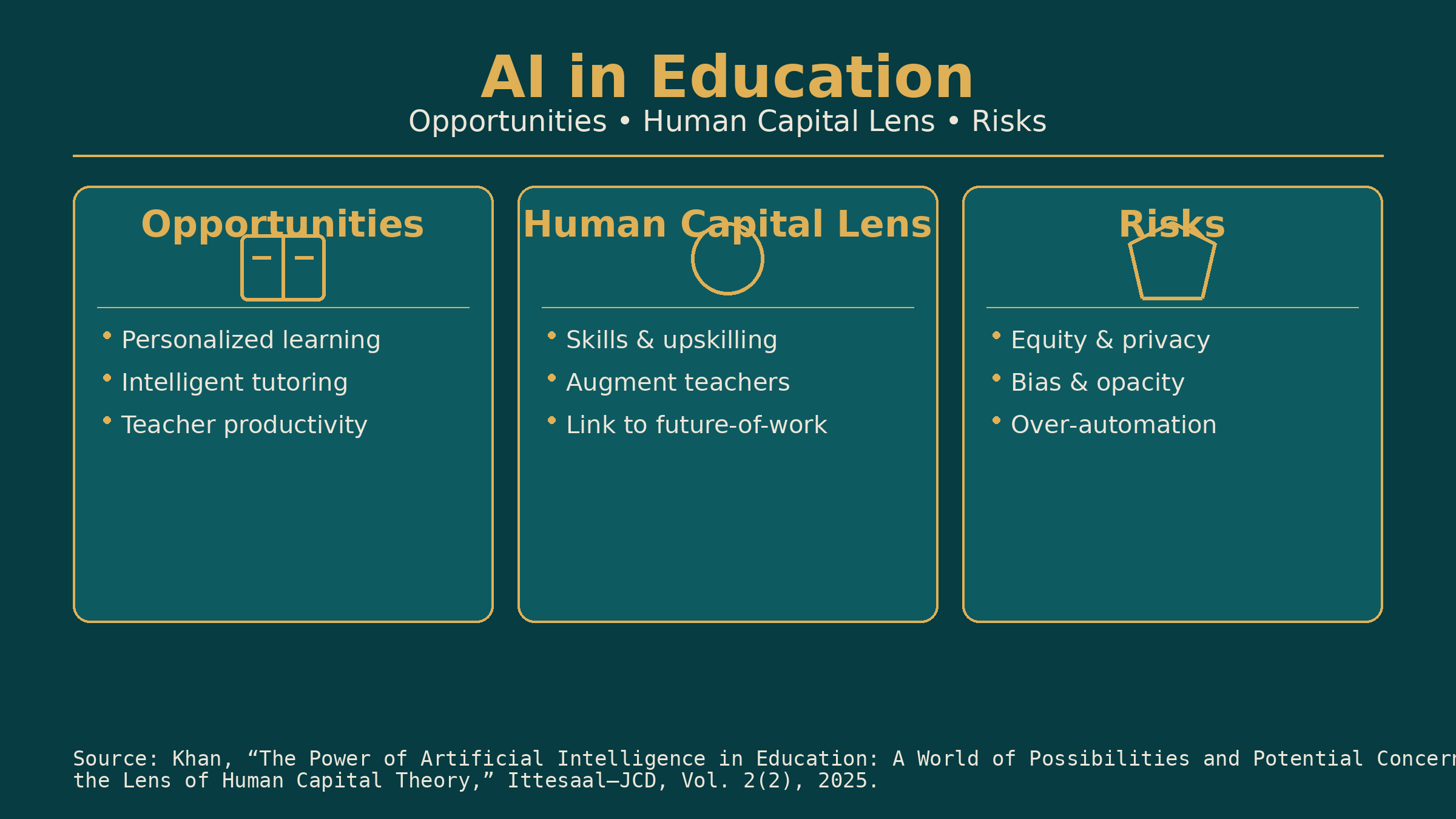
With the advent of industrialization and technological advances, the world could no longer be understood within country boundaries. The interconnectivity of ideals, cultures and religion that has emerged through the exchange of trade, commerce, communication and Enlightened ideals gave birth to globalization. The impact of globalization is multi-dimensional that can be felt over every domain and aspect of life ranging from socio-culture to economy, religion to ideologies etc. Individual lives and society is being reshaped or recreated by this wave of change. In order to comprehend the concept of globalization, scholars have contributed in developing theories and approaches that may enable society towards a global culture. Among myriads of these approaches, ‘globalization as competition’ garnered much research and debate. The current study is focused on the theoretical approach of Human Capital Theory (HCT); and its global trend ‘Artificial Intelligence’ (AI). The aim of this paper is to re-conceptualize globalization responsibly by emphasizing on the question whether AI is a hope for a benevolent future or is it a threat to education on global level. After critically analyzing the significance and impact of HCT on education, the next section of this paper will briefly introduce AI within educational context. Furthermore, it will explore the unlimited new possibilities for global education. The third section will relate AI to competitive global theory, drawing implications from HCT within the context of education. Based on the implications of previous two sections, the fourth section will examine the potential dangers of AI-driven-education in the near future. Lastly, we will conclude the study by speculating the multifaceted role of AI, its challenges and implications in education respectively.
Downloads
References
Ammer, Mohammed Abdullah., Zeyad A. T. Ahmed, Saleh Nagi Alsubari, Theyazn H. H. Aldhyani, and Shahab Ahmad Almaaytah. “Application of Artificial Intelligence for Better Investment in Human Capital.” Mathematics 11, no. 3 (2023): 612, https://doi.org/10.3390/math11030612 DOI: https://doi.org/10.3390/math11030612
Andreotti, Vanessa. Actionable Postcolonial Theory in Education. Basingstoke: Palgrave Macmillan, 2011. DOI: https://doi.org/10.1057/9780230337794
Becker, G.S. Human Capital: A Theoretical and Empirical Analysis, with Special Reference to Education. Chicago: University of Chicago Press, 1964.
Bomfim, Felipe Rodrigues., Marta Carolina Gimenez Pereira. “Human Capital Theory in the context of Artificial Intelligence.” Academic Star Publishing Company 12 (03), (2021): 272–277, https://doi.org/10.15341/jbe(2155-7950)/03.12.2021/005
Bruel, Antoine. “Future of Work: Disrupting Human Capital with AI.” Braincities, 2019, https://braincities.medium.com/future-of-work-disrupting-human-capital-with-ai-24dc216e9e83 [Accessed 12 Mar. 2024].
Burton, Sharon L. “Grasping the Cyber-world: Artificial Intelligence and Human Capital Meet to Inform Leadership.” International Journal of Economics, Commerce and Management United Kingdom VII (12), (2019): 707–758, https://ijecm.co.uk/wp-content/uploads/2019/12/71247.pdf
Carter, Matt. Minds and Computers: An Introduction to the Philosophy of Artificial Intelligence. Edinburgh: Edinburgh University Press, 2007. DOI: https://doi.org/10.1515/9780748629305
Clarke, John J. Oriental Enlightenment: The Encounter between Asian and Western Thought. New York: Routledge, 1997.
Copeland, B. J. “Artificial intelligence - Methods and goals in AI,” Encyclopædia Britannica, 2019, Available at: https://www.britannica.com/technology/artificial-intelligence/Methods-and-goals-in-AI.
Chen, Xieling., Haoran Xie, Di Zou, Gwo-Jen Hwang. “Application and Theory Gaps During the Rise of Artificial Intelligence in Education.” Computers and Education: Artificial Intelligence 1(1), (2020): 100002, https://doi.org/10.1016/j.caeai.2020.100002. DOI: https://doi.org/10.1016/j.caeai.2020.100002
Cohen, L. “AI Advances Risk Facilitating Cyber-crime, Top US Officials Say.” Reuters, 09-01-2024, https://www.reuters.com/technology/cybersecurity/ai-advances-risk-facilitating-cyber-crime-top-us-officials-say-2024-01-09/. [Accessed 24 Apr. 2024].
Giddens, Anthony. Sociology. 5th ed. Oxford: Blackwell Publishers, 2006.
Gillies, Donald. “State Education as High-Yield Investment: Human Capital Theory in European Policy Discourse.” Journal of Pedagogy/Pedagogický casopis 2 (2), (2011): 224–245, https://doi.org/10.2478/v10159-011-0011-3 DOI: https://doi.org/10.2478/v10159-011-0011-3
Gillies, Donald. “Human Capital Theory in Education.” Encyclopedia of Educational Philosophy and Theory, (2015), https://doi.org/10.1007/978-981-287-532-7_254-1 DOI: https://doi.org/10.1007/978-981-287-532-7_254-1
Gulson, Kalervo N. “Artificial Intelligence and a New Global Policy Problem in Education.” In Fazal Rizvi, Bob Lingard, and Risto Rinne, editors, Reimagining Globalization and Education. 79-91, New York: Routledge, 2022, https://doi.org/10.4324/9781003207528 DOI: https://doi.org/10.4324/9781003207528-6
Hakiki, Muhammad., Radinal Fadli, Agariadne Dwinggo Samala, Ade Fricticarani, Popi Dayurni, Kurniati Rahmadani, Ayu Dewi Astiti, Arisman Sabir. “Exploring the Impact of using Chat-GPT on Student Learning Outcomes in Technology Learning: The Comprehensive Experiment.” Advances in Mobile Learning Educational Research 3 (2), (2023): 859–872, https://doi.org/10.25082/AMLER.2023.02.013 DOI: https://doi.org/10.25082/AMLER.2023.02.013
Iansiti, Marco., and Karim R. Lakhani. Competing in the Age of AI: Strategy and Leadership when Algorithms and Networks Run the World. Boston, MA: Harvard Business Review Press, 2022.
Kerres, Michael., Josef Buchner. “Education after the Pandemic: What We Have (Not) Learned about Learning.” Education Sciences 12 (5), (2022): 315, https://doi.org/10.3390/educsci12050315 DOI: https://doi.org/10.3390/educsci12050315
Lowood, Henry E. “Virtual Reality: Computer Science.” Encyclopedia Britannica, 2018, Available at: https://www.britannica.com/technology/virtual-reality
Lu, Chia-Hui. “The Impact of Artificial Intelligence on Economic Growth and Welfare.” Journal of Macroeconomics 69, (2021): 103342, https://doi.org/10.1016/j.jmacro.2021.103342 DOI: https://doi.org/10.1016/j.jmacro.2021.103342
McGee, Robert W. “Is Chat GPT Biased Against Conservatives? An Empirical Study.” SSRN Electronic Journal (2023), https://doi.org/10.2139/ssrn.4359405 DOI: https://doi.org/10.2139/ssrn.4359405
Prodromou, Elizabeth H. “U.S. Foreign Policy and Global Religious Pluralism.” In T. Banchoff, ed., Religious Pluralism, Globalization and World Politics. New York: Oxford University Press, 2008. DOI: https://doi.org/10.1093/acprof:oso/9780195323405.003.0012
Schultz, Theodore W. “Reflections on Investment in Man.” Journal of Political Economy 70 (5, Part 2), (1962): 1–8, https://doi.org/10.1086/258723 DOI: https://doi.org/10.1086/258723
Schultz, Theodore W. Education and Productivity. Washington, D.C., 1972.
Shields, Robin. Globalization and International Education. New York: Bloomsbury Academic, 2013. DOI: https://doi.org/10.5040/9781472552990
Stein, Sharon., Vanessa Andreotti, Cash Ahenakew, Dallas Hunt. “The Complexities and Paradoxes of Decolonization in Education.” In Reimagining Globalization and Education. edited by Fazal Rizvi, Bob Lingard, and Risto Rinne, 197-212, New York: Routledge, 2022. DOI: https://doi.org/10.4324/9781003207528-14
Al-Tkhayneh, Khawlah M., Emad M. Alghazo, and Dina Tahat. “The Advantages and Disadvantages of Using Artificial Intelligence in Education.” Journal of Educational and Social Research 13 (4), (2023): 105, https://doi.org/10.36941/jesr-2023-0094 DOI: https://doi.org/10.36941/jesr-2023-0094
Tonini, Donna C. “Human Capital Theory in Comparative and International Education: Development, Application and Problematics.” In Tavis D Jules, Robin Shields, and Mathew A. M. Thomas, editors, The Bloomsbury Handbook of Theory in Comparative and International Education. London: Bloomsbury, 2021. DOI: https://doi.org/10.5040/9781350078789.ch-004
Published
Issue
Section
License
Copyright (c) 2025 Bukhatawar Khan

This work is licensed under a Creative Commons Attribution 4.0 International License.
This work is licensed under a Creative Commons Attribution 4.0 International License. Authors retain copyright and grant the journal right of first publication with the work simultaneously licensed under a Creative Commons Attribution (CC-BY) 4.0 License that allows others to share the work with an acknowledgement of the work’s authorship and initial publication in this journal.
How to Cite