
Negotiating Authority: Ulama and Family Law Reforms in Pakistan
DOI:
https://doi.org/10.64984/ijcd.2.2.2025.23Keywords:
Pakistan Family Laws, Talāq, Khula, polygamy, modern reforms, Islamic jurisprudence , fiqh, women rights, judicial ijtihadAbstract
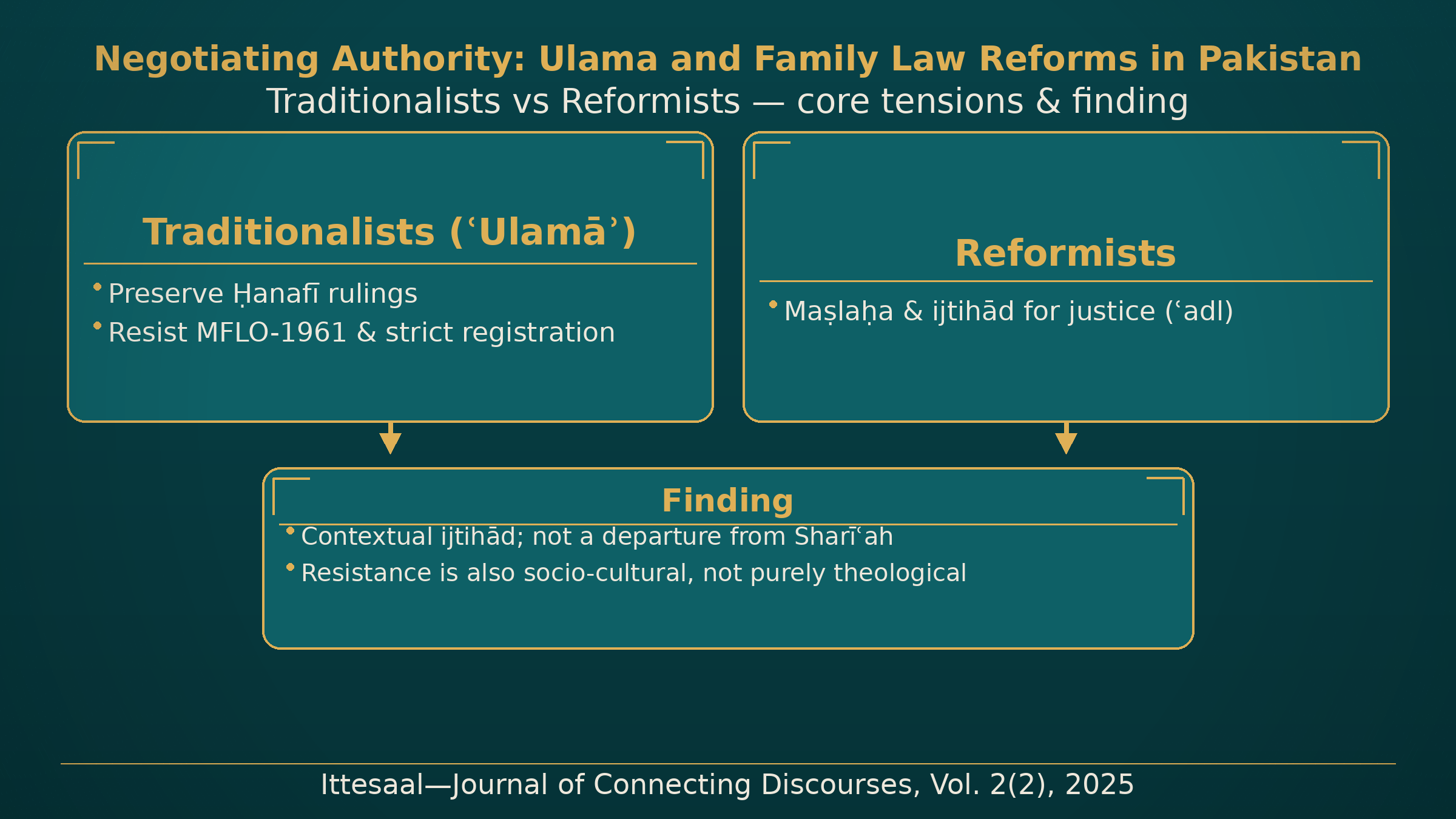
The institution of family is regarded as a significant unit of society in Islam, so family laws are pivotal in the legal system of Pakistan. Pakistan has adopted Anglo- Muhammadan Law post-independence which is a combination of Islamic principles and colonial interpretations of the British. Since then, the State of Pakistan is attempting to reconcile Islamic tradition with modern legal needs through reforms and judicial activism through ijtihād (also termed as judicial ijtihad). The current study examines the evolution of Islamic family laws in Pakistan from their classical juristic foundation to contemporary initiatives in legal reform. Pakistani laws are primarily rooted in Islamic fiqh reflecting a complex interaction between Sharī‘ah, colonial legal legacies, constitutional mandates and modern socio-political demands. With an emphasis on how tradition and reform have coexisted, clashed, and changed the legal status of women in areas like marriage, divorce, and maintenance__ this paper examines the historical development, legal underpinnings, and socio-religious discussions surrounding Muslim family laws in Pakistan. By tracing the transition from traditional norms to reform-oriented legal mechanism, this paper attempts to seek answers to questions like why reforms in family laws of Pakistan are needed. Whether the family laws of Islam are secular and anti-Islamic? And whether the reluctance and resistance to accept laws in reform is of religious nature or a threat to patriarchal and authoritative behavior? Consequently, the paper argues that the reforms in Pakistan’s family laws are not departure from Islam, but a contextual reinterpretation aimed at addressing contemporary social realities.
Downloads
References
Abbasi, Zubair, and Shehbaz Ahmad Cheema. "Historical Context of Muslim Family Law in Pakistan." In Family Laws in Pakistan, by Zubair Abbasi and Shehbaz Ahmad Cheema, 9-22. Oxford University Press, 2024. DOI: https://doi.org/10.2139/ssrn.5702650
Ahmad, Mujeeb. "Ulamā’ and the Muslim Family Laws in Pakistan." Islamic Studies 59, no. 1 (2020): 51-78. DOI: https://doi.org/10.52541/isiri.v59i1.1169
Ahmad, Mumtaz. "The Muslim Family Law Ordinance of Pakistan." International Journal on World Peace 10, no. 3 (1993): 37-46.
Ali, Khadija., and Meerum Inam. Domestic Violence: Policy Brief. Policy Brief, National Commission for Human Rights, Pakistan, Government of Pakistan, 2023.
All Pakistan Women's Association. 1948. https://www.apwanational.com/ (accessed January 11, 2025).
Al-Maqdisi, Ibn Qudamah. al-Mughni. VIII. Vol. 8. Dar 'Alam al Kutub, 1223 [2013].
al-Marghinani, Burhan-ul-Din. The Hidaya or Guide: A Commentory on the Musalman Law. Translated by Charles Hamilton. Vol. 1. Cambridge University Press, 2013.
Arafat, Yasir. "The Dissolution Of Muslim Marriage Act, 1939 May Provide More Rights to Women of Subcontinent if Applied According to True Doctrine of Maliki School of Islamic Jurisprudence: An Overview." The Journal of Applied Social Sciences 1 (2015): 59-74. DOI: https://doi.org/10.46568/pjass.v1i1.280
Carlisle, Jessica. Muslim Divorce in the Middle East: Contesting Gender in the Contemporary Courts. Switzerland: Palgrave Pivot, 2019. DOI: https://doi.org/10.1007/978-3-319-77007-9
"Constituent Assembly of Pakistan 1949." Karachi, 1949. 65-102. DOI: https://doi.org/10.1515/crll.1949.186.65
Coulson, N. J. "Reform of Family Law in Pakistan." Studia Islamica 7 (1957): 135-155. DOI: https://doi.org/10.2307/1595022
Critelli, Filomena M. "Between Law and Custom: Women, Family Law and Marriage in Pakistan." Journal of Comparative Family Studies 43, no. 5 (2012). DOI: https://doi.org/10.3138/jcfs.43.5.673
"Dissolution of Muslim Marriage Act, 1939." The Pakistan Code: Ministry of Law and Justice. 1939. https://pakistancode.gov.pk/english/UY2FqaJw1-apaUY2Fqa-cJaW-sg-jjjjjjjjjjjjj (accessed January 28, 2025).
Ghamadi, Javed Ahmad. Al-Mīzān. Lahore: Almoord Idara Ilm o Tehqeeq, 1990.
Judgment Sheet in the Lahore High Court Multan Bench, Multan Judicial Department. Lahore, 2021.
Khan, Hooria Hayat, and Azmeh Khan. "Women’s Rights and the Nikāh Nama in Pakistan." 2019. https://www.cerp.org.pk/wp-content/uploads/2023/06/41_20200504004625.pdf (accessed August 10, 2022).
Kilani, Abdul Rehma. Tīn Ṭalāq aur inkā Shar‘ī Ḥal. Lahore: Dar-ul-Salam, n.d.
Shiekh, Wajih Ahmad. "Lahore High Court Rules Marriage without completing Iddat not Void." Dawn.com, Januray 08, 2022, https://www.dawn.com/news/1668239
Mehdi, Rubya. The Islamization of the Law in Pakistan. Nordic Institute of Asian Studies Monograph series. 60 vols. Richmond: Curzon Press, 1994.
"Muslim Family Law Ordinance, 1961." The Pakistan Code: Ministry of Law and Justice. 1961. https://pakistancode.gov.pk/english/UY2FqaJw1-apaUY2Fqa-apaUY2Npa5po-sg-j (accessed February 3, 2025).
Nadim, Khursheed. "Khula aur Tanseekh Nikāh." [Khula and Cancelation of Nikah]. Dunya News. February 2, 2015.
Rahman, Fazlur. " Survey of Modernization of Muslim Family Law." International Journal of Middle East Studies 11, no. 4 (1980): 451-465. DOI: https://doi.org/10.1017/S0020743800054817
Rushd, Ibn. The Distinguished Jurist Premier: Bidāyat al-Mujtahid wa Nihāyat al-Muqtaṣid. Translated by Imam Ahsan Khan Nyazee. Vol. II. Garnet Publishing, 2000.
Al-Rushdi, Abu Ammar Zahid. Pakistan Mein Nifaz-e-Shariat Ki Mutafiqah Dastavezat [Agreed/Consensus Documents on the Implementation of Sharia in Pakistan]. Karachi: Mahnamah Awan-e-Islam Monthly Awan-e-Islam, 2001.
Sabreen, Mudasra. "The Judiciary-led Islamization of Family Law in Pakistan: An Analysis." Islamic Studies 59, no. 2 (2020): 203-224. DOI: https://doi.org/10.52541/isiri.v59i2.1406
Sarhan, Mohammad Ibrahim. "Rulings on Iddah in Islamic Sharia: A Jurisprudential Study." Migration Letters, 2023: 698-707.
Tanzeel-ul-Rehman. Majmū‘a Qawānīn-i-Islām. Vol. 1. Islamabad: Idara Tahqiqat-e-Islam, 1976.
"The Family Courts Act, 1964." The Pakistan Code: Ministry of Law and Justice. 1964. https://pakistancode.gov.pk/english/ (accessed February 02, 2025).
"The Universal Declaration of Human Rights." United Nations. 1948. https://www.un.org/en/about-us/universal-declaration-of-human-rights (accessed January 28, 2025).
Views on Divorce Rate in Pakistan; 48% Believe it Has increased, of Whom Majority Believes it is Due to Lack of Patience. Prod. Gilani Research Foundation. Islamabad, June 02, 2010.
Zaman, Muhammad. "Exchange Marriage System and Muslim Family Laws in Pakistan." Pakistan Journal of History and Culture XXXIII, no. I (2012): 2-12.
Published
Issue
Section
License
Copyright (c) 2025 Aishath Khaleela Abdul Sattar, Farkhanda Yousaf

This work is licensed under a Creative Commons Attribution 4.0 International License.
This work is licensed under a Creative Commons Attribution 4.0 International License. Authors retain copyright and grant the journal right of first publication with the work simultaneously licensed under a Creative Commons Attribution (CC-BY) 4.0 License that allows others to share the work with an acknowledgement of the work’s authorship and initial publication in this journal.
How to Cite