
The Seerah Paradigm of Emotional Intelligence: Prophetic Ways of Knowing and Being
DOI:
https://doi.org/10.64984/ijcd.2.2.2025.19Keywords:
Emotional Intelligence (EI), Effective Leadership and Management, Prophetic Model, Islamic Ethics, SeerahAbstract
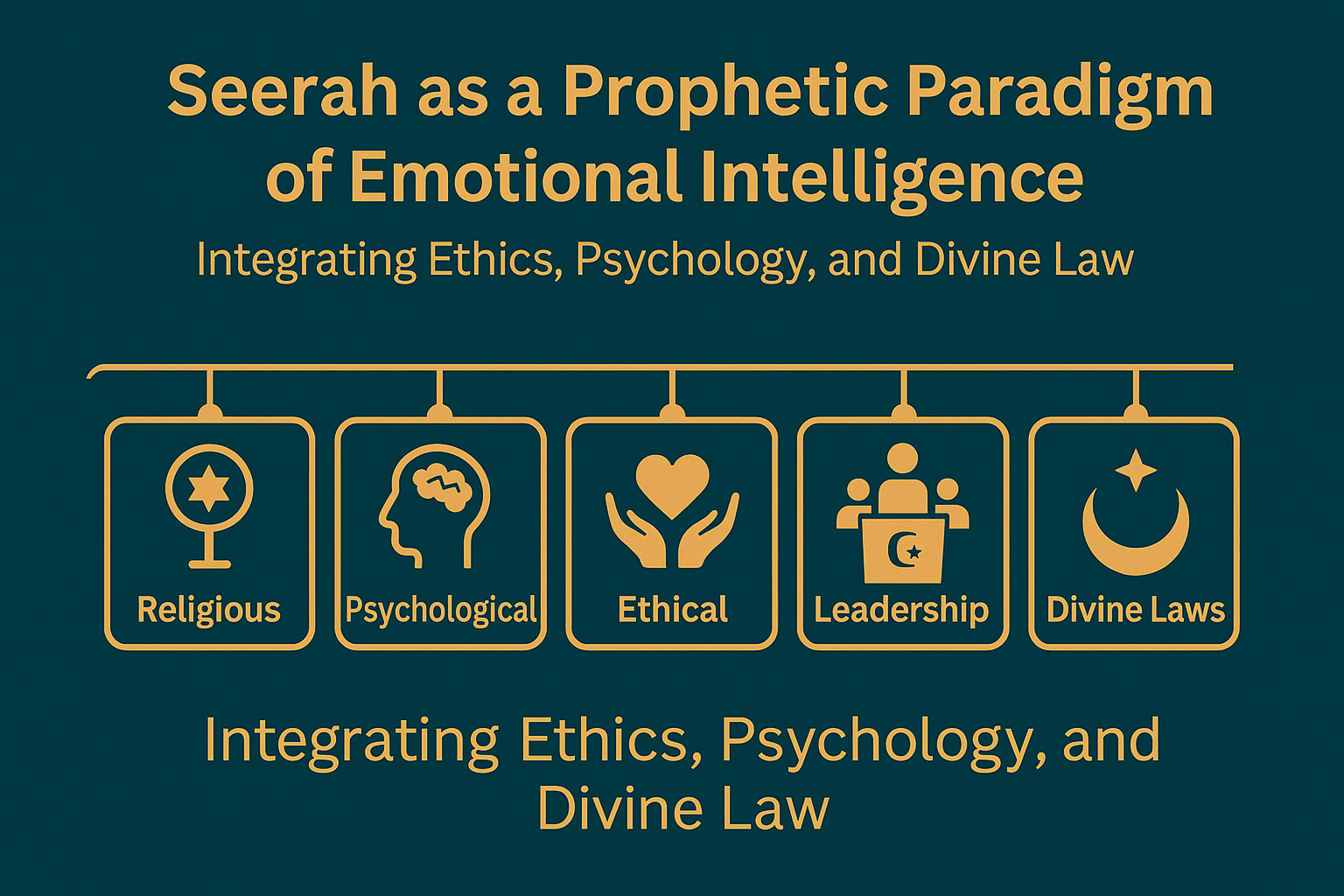
Emotional intelligence is the capacity to understand one’s emotions, skills, and thoughts. In psychology and organizational management, studying one’s own, others’, or groups’ emotions has become a cornerstone. This article examines emotional intelligence through a prophetic model guided by the teachings and practices of Seerah literature. To illustrate the core principles of emotional intelligence, the study is built on an integrated model that considers classical Islamic teachings of the Prophet Muhammad as Seerah, along with a contemporary emotional intelligence (EI) and leadership framework. By adopting a comparative approach, this study is guided by an interdisciplinary analysis that draws on Islamic studies, organisational behaviour and management, and psychology. The study identified self-awareness, self-regulation, and empathy as religiously governed skills that are deeply embedded in Islamic ethics and moral values. The findings present a comparative discourse analysis that discusses how the prophetic model is exemplified through effective leadership, emotional intelligence, and behavior. Contemporary applications of emotional intelligence (EI) are explored along with effective leadership to show compassionate leadership with an integrated model of emotional intelligence principles and Islamic teachings. The study intended to highlight five key components of EI: religious, psychological, ethical, leadership, and divine laws. In line with the Qur’ānic verses, it suggests that EI skills can be helpful to look at Seerah and the Prophetic model as a direction to achieve guidance in all aspects.
Downloads
References
Alghamdi, Abdullah. A. “Role of Islamic Educational Values in Developing Emotional Intelligence Skills.” Graduate Student Theses, Dissertations, and Professional Papers, 4980: University of Montana, 2006, https://scholarworks.umt.edu/etd/4980
Brackett, Marca A., John D. Mayer, Rebecca M. Warner. “Emotional Intelligence and its Relation to Everyday Behaviour.” Personality and Individual Differences 36 (6), (2004): 1387–1402, https://doi.org/10.1016/s0191-8869(03)00236-8
Anastasya, Aqillah., Dilla Agustin, Meutia Muslimah, M. Faidullah Akbar. “Reading the Qur’ānic Habits with Religious Behavior in Islamic Psychology.” International Journal of Community Care of Humanity (IJCCH) 2 (1), (2024): 41–48, https://journal.lsmsharing.com/ijcch/article/view/39
Antonopoulou, Hera. “The Value of Emotional Intelligence: Self-Awareness, Self-Regulation, Motivation, and Empathy as Key Components.” Technium Education and Humanities 8, (2024): 78-92, https://doi.org/10.47577/teh.v8i.9719
Aristyasari, Yunita. “Synergizing Progressive Values and Social, Emotional, Spiritual Intelligence in Islamic Education in The Digital Era.” Third International Conference on Sustainable Innovation 2019 – Humanity, Education and Social Sciences (IcoSIHESS 2019), Advances in Social Science, Education and Humanities Research, volume 353, https://doi.org/10.2991/icosihess-19.2019.75
Bauer, Karen. “Emotion in the Qur’ān: An Overview.” Journal of Qur’ānic Studies 19 (2), (2017): 1–30, https://doi.org/10.3366/jqs.2017.0282
Bauer, Karen. “The Emotions of Conversion and Kinship in the Qur’an and the Sīra of Ibn Isḥāq.” Cultural History 8 (2), (2019): 137–163, https://doi.org/10.3366/cult.2019.0197
Boddice, Rob. “Review of The History of Emotions: An Introduction.” (review no. 1752), in Reviews in History, https://doi.org/10.14296/rih/2014/1752, https://reviews.history.ac.uk/review/1752/
Esposito, John L. Islam: The Straight Path. Oxford University Press, 1998.
Gazi, Md. Abu Issa Md. Atikur Rahaman, Md. Masum, Shamal Mia, Mohammad Fakhrul Islam, Md. Nurun Nabi, Abdul Rahman bin S. Senathirajah. “Navigating Organizational Management: Islamic Insights on Unity of Command and Unity of Direction.” Journal of Infrastructure, Policy and Development 8 (15), (2024): 9478, https://doi.org/10.24294/jipd9478
Gerhardt, Katharina., Robin Bauwens, Marianne van Woerkom. “Emotional Intelligence and Leader Outcomes: A Comprehensive Review and Roadmap for Future Inquiry.” Human Resource Development Review 0 (0) (2025): 1-51, https://doi.org/10.1177/15344843251342689
Gillani, Iram., Amber Ferdoos. “Heart Intelligence from Qur’ān and Science: An Integrated Approach for the Evolution of Enlightened Self in the Society.” International Research Journal on Islamic Studies 4 (1), (2022): 01-17, https://doi.org/10.54262/irjis.04.01.e01
Gransberry, Christopher K. “How Emotional Intelligence Promotes Leadership and Management Practices.” Public Organization Review 22 (4), (2021): 935–948, https://doi.org/10.1007/s11115-021-00550-4
Hanefar, Shamsiah Banu., Che Zarrina Sa’ari, Saedah Siraj. “A Synthesis of Spiritual Intelligence Themes from Islamic and Western Philosophical Perspectives.” Journal of Religion and Health 55 (6), (2016): 2069–2085, https://doi.org/10.1007/s10943-016-0226-7.
Hasson, Gill. Understanding Emotional Intelligence. Pearson UK, 2015, https://api.pageplace.de/preview/DT0400.9781292084183_A24619397/preview-9781292084183_A24619397.pdf
Ibrahim, Lawan., Habu Bah-yaye Adamu. “Participative Management: A Model of Islamic Perspective of Management (Shura) in an Organization.” Global Journal of Management and Business Research: Administration and Management 19 (10), (1019): 35-42.
Ikhsan, Muhammad., Busral. “The Art of Communication of the Prophet Muhammad in the Hadith: Strategies for Building Social Relationships and Preaching.” Journal of Islamic Communication and Journalism 1 (1), (2025): 10-20.
Issah, Mohammed. “Change leadership: the Role of Emotional Intelligence.” SAGE Open 8 (3), (2018): 1–6, https://doi.org/10.1177/2158244018800910
Jack, Anthony Ian., Jared Parker Friedman, Richard Eleftherios Boyatzis, Scott Nolan Taylor “Why Do You Believe in God? Relationships between Religious Belief, Analytic Thinking, Mentalizing and Moral Concern.” PLOS ONE 11 (3), (2016): e0149989, https://doi.org/10.1371/journal.pone.0149989
Kanesan, Pavitra., and Norsiah binti Fauzan. “Models of Emotional Intelligence: A Review.” e-Bangi Journal of Social Science and Humanities 16 (7), (2019): 1-9, http://www.ejournal.ukm.my
Kanwal, Shamsa. “Resolution of Psychological Problems in the Perspective of Seerah.” Abḥās̱ 8 (30), (2023): 1-15, https://doi.org/10.54692/abh.2023.08301882
Karimpour, Shahin., Arezou Sayad, Mohammad Taheri, Khadijeh Aerab Sheibani. “A Gender Difference in Emotional Intelligence and Self-Regulation Learning Strategies: Is it true?” Novelty in Biomedicine 7 (2), (2019): 38-44, https://doi.org/10.22037/nbm.v7i2.20974
Kock, Ned., Milton Mayfield, Jacqueline Mayfield, Shaun Sexton, Lina M. De La Garza. “Empathetic Leadership: How Leader Emotional Support and Understanding Influences Follower Performance.” Journal of Leadership and Organizational Studies 26 (2), (2018): 217–236, https://doi.org/10.1177/1548051818806290
Kurniawan, Agung., Abdul Syakur, “The Correlation of Emotional Intelligence and Spiritual of Intelligence to Effectiveness Principals of Leadership.” International Journal of Psychological and Brain Sciences 2 (1), (2017): 1, https://doi.org/10.11648/j.ijpbs.20170201.11
Lewis, Gary J., Stuart J. Ritchie, Timothy C. Bates. “The Relationship between Intelligence and Multiple Domains of Religious Belief: Evidence from a Large Adult US Sample.” Intelligence 39 (6), (2011): 468–472, https://doi.org/10.1016/j.intell.2011.08.002
Mirela, Tiarani., Zainul Arifin, M. Jamroh, Kaspul Anwar Us. “Prophetic Leadership: Examining the Prophetic Leadership Concept of the Prophet Muhammad SAW.” INNOVATIO: Journal for Religious Innovation Studies 21 (1), (2021): 62–74, https://doi.org/10.30631/innovatio.v21i1.130
Pizarro, David., Eric Uhlmann, Peter Salovey. “Asymmetry in Judgments of Moral Blame and Praise.” Psychological Science 14 (3), (2023): 267–272, https://doi.org/10.1111/1467-9280.03433
Rajput, Namita., Urvashi Sharma, Monika Sharma, Liliana Vaca-Montenegro, Erika Machado-Falconi, Wilma Eugenia Meneses Rosas. “The Role of Emotional Intelligence in Effective Leadership and Management.” Journal of Informatics Education and Research 3 (2), (2023): 1655-1661, https://doi.org/10.52783/jier.v3i2.292
Rasli, Amran., Salman Bashir Memon, Silvi Asna Prestianawati, and Imelda Hermilinda Abas. “Leadership Lessons from the Battle of Uhud.” Journal of Islamic Thought and Civilization 14, no. 2 (December 24, 2024): 355-369, https://doi.org/10.32350/jitc.142.21, https://journals.umt.edu.pk/index.php/JITC/article/view/6085.
Rozell, Elizabeth J., Charles E. Pettijohn, and R. Stephen Parker. “An Empirical Evaluation of Emotional Intelligence.” Journal of Management Development 21 (4), (2022): 272–289, https://doi.org/10.1108/02621710210430272
Santra, Adrinil. “Understanding Emotional Intelligence in the Light of Qur’ānic Wisdom and Prophetic Traditions.” Proceedings of ISER International Conference, Riyadh, Saudi Arabia, 30th June 2016, https://www.worldresearchlibrary.org/up_proc/pdf/365-146985745811-17.pdf
Tahir, M., and Salih Yucel. “Motivational Techniques for Teaching: Prophetic Model.” International Journal of Teaching and Education VII (2), (2019): 70-85, https://doi.org/10.20472/te.2019.7.2.006
Udin, Udin., Radyan Dananjoyo. “Prophetic leadership: Lessons from the Greatest Leader of Prophet Muhammad.” FWU Journal of Social Sciences 17 (4), (2023): 88-97.
Usman, Abur Hamdi., Rahmahtunnisah Sailin, Muhammad Faiz Mukmin Abdul Mutalib. “The Prophetic Arts of Communication: Some Reflections on Humanity.” Humanities and Social Sciences Reviews 7 (4), (2019): 377–384, https://doi.org/10.18510/hssr.2019.7449
V. V., Zaritskaya., and N. M. Falko. “Self-Control and Self-Regulation of Emotions in The Structure of Emotional Intelligence.” In The Innovative Potential of Psychology in the Development of the Modern Man, 92-111. Lviv-Toruń Liha -Press 2019, https://doi.org/10.36059/978-966-397-133-9/92-111, https://ekhsuir.kspu.edu/server/api/core/bitstreams/5d4e70b2-3d82-4adf-98a9-0bdc69b77fb6/content
Vaughan, Frances. “What is Spiritual Intelligence?” Journal of Humanistic Psychology 42 (2), (2002): 16–33, https://doi.org/10.1177/0022167802422003
Wahab, Mastura Ab. “Islamic Spiritual and Emotional Intelligence and Its Relationship to Eternal Happiness: A Conceptual Paper.” Journal of Religion and Health 61 (6), (2022): 4783–4806, https://doi.org/10.1007/s10943-021-01485-2
Wijaya, Ida Suryani., M. Tahir, Rega Armella, Andi Muhammad Abdi. “The Role of Spiritual Intelligence in Developing Individual Emotional Intelligence in Interacting Based on an Islamic Perspective.” Pharos Journal of Theology 106.3. (2025): 1-13, https://doi.org/10.46222/pharosjot.106.301
Wijaya, Ida Suryani., M. Tahir, Saputranur, Sai Handari. “The Role of Piety (Taqwa) and Gratitude (Syukur) in Islam on Human Emotional Intelligence.” Pharos Journal of Theology105 (2), (2024): 1-13, https://doi.org/10.46222/pharosjot.105.24
Wu, Shwu-Ming. “Emotional Intelligence and Workplace Spirituality in Predicting Career Success of High-Tech Leaders.” Behavioral Sciences 14 (11), (2024): 1009, https://doi.org/10.3390/bs14111009
Yustisia, Satia., Widya Yeney Prihatiningtias. “Pengaruh Kecerdasan Intelektual, Emosional, Spiritual, Dan Sosial Terhadap Persepsi Mahasiswa Mengenai Laba Akuntansi.” [The Influence of Intellectual, Emotional, Spiritual, and Social Intelligence on Students' Perceptions of Accounting Profit]. Jurnal Ilmiah Mahasiswa 1 (2), (2012).
Zekkoub, Abdelali Bey., Yasser Mohamed Tarshany, and Fouad Bounama. “Aspects of Emotional Intelligence Based on the Noble Qurʾān: An Analytical Study.” Asian Social Science 19 (3), (2023): 1–1, https://doi.org/10.5539/ass.v19n3p1
Zuckerman, Miron., Jordan Silberman, and Judith A. Hall. “The Relation between Intelligence and Religiosity.” Personality and Social Psychology Review, 17 (4), (2023): 325–354, https://doi.org/10.1177/1088868313497266
Published
Issue
Section
License
Copyright (c) 2025 Tajuddin Sanni

This work is licensed under a Creative Commons Attribution 4.0 International License.
This work is licensed under a Creative Commons Attribution 4.0 International License. Authors retain copyright and grant the journal right of first publication with the work simultaneously licensed under a Creative Commons Attribution (CC-BY) 4.0 License that allows others to share the work with an acknowledgement of the work’s authorship and initial publication in this journal.
How to Cite