
Contribution of Jürgen Habermas in Contrast to the First Generation of Frankfurt School of Thought
DOI:
https://doi.org/10.64984/ijcd.2.1.2025.05Keywords:
Frankfurt School, Conflict Theory, Theory of Communicative Action, Public Sphere, Rationality, modernityAbstract
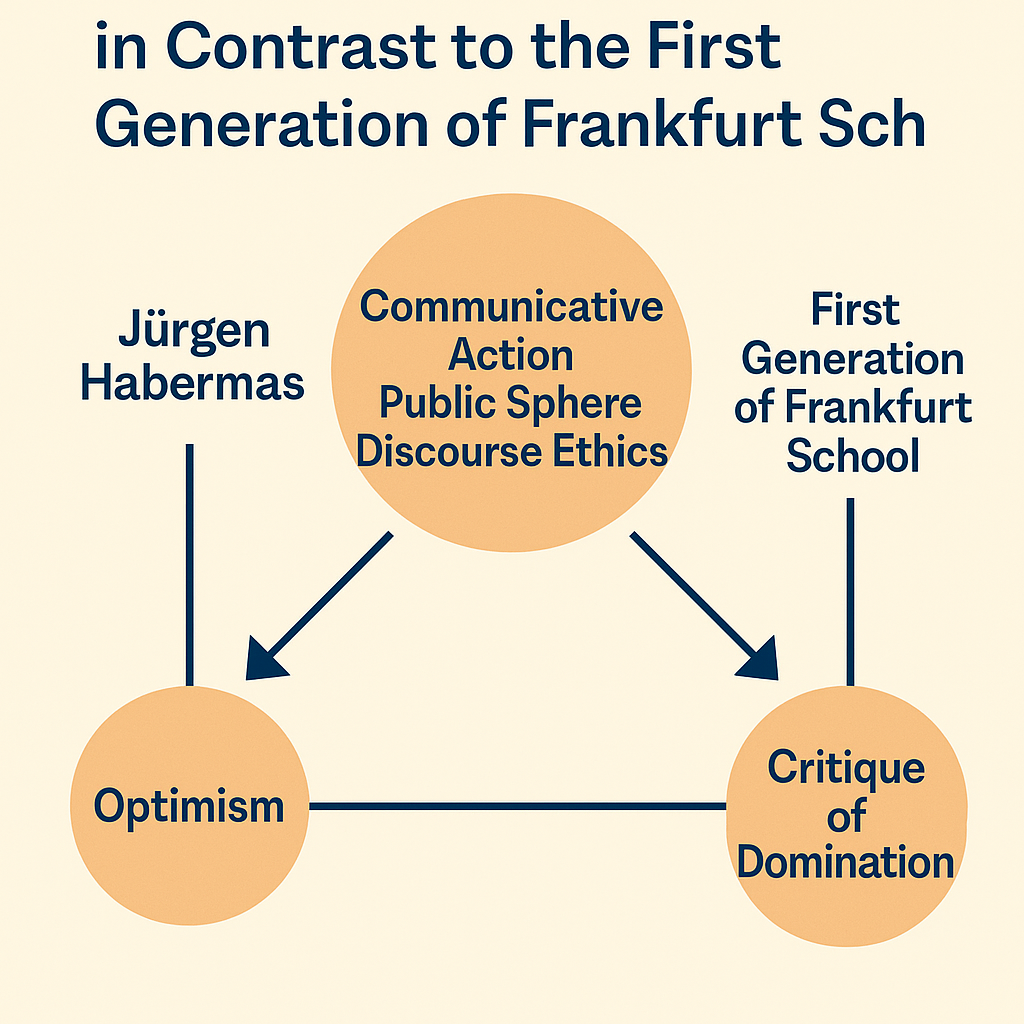
Initial generation of Frankfurt School of Thought put forth social critique of modernity and capitalism and how they justify their supremacy over nations and people. Max Horkheimer, Herbert Marcuse, Theodor W. Adorno, Erich Fromm, and Walter Benjamin are chief proponents of this theory. It is noteworthy how this movement started in Germany during WWII and spreads around the world in 1930s. Conflict theorists interpreted various philosophers’ ideas, especially those of, Karl Marx, Hegel, and Sigmund Freud etc. They dismissed rationality because it can lead to violence and barbarianism if logically justified. The mythological battle of troy, the horrors of holocaust are all examples of how rationality is capable of mass destruction. By 1970s another generation, started by Jürgen Habermas, initiated the dialogue between continental and analytics tradition. Contrary to the first generation, he did not believe in pessimist understanding of reason and tried to re-establish it without falling in the pit of objectivism. The foremost section is based on a brief biography of Jürgen Habermas. The later section of the paper enumerates a comparative analysis to see how Habermas perspective on modernity and rationality are different from the first generation of Frankfurt school of thought. The third and fourth section was reserved for the detailed discussion and critique of his ideas. Lastly, the paper asserted as to whether Habermas relevance in the 21st century outweighs his predecessors or not.
Downloads
References
Adorno, Theodor W., and Max Horkheimer. Dialectic of Enlightenment. London: Verso, 1944.
Benhabib, Seyla. “The Embattled Public Sphere: Hannah Arendt, Juergen Habermas and Beyond.” Theoria 44 (90), (1997): 1–24, https://doi.org/10.3167/th.1997.449002.
Bohman, James., and William Rehg. “Jürgen Habermas.” Stanford Encycliopaedia of Philosophy. May 17, 2007, https://plato.stanford.edu/entries/habermas/ (accessed November 19, 2019).
Boeder, Pieter. “Habermas’ Heritage: The Future of the Public Sphere in the Network Society.” First Monday 10 (9), (2005), https://doi.org/10.5210/fm.v10i9.1280.
Cherem, Max. “Jürgen Habermas.” Internet Encyclopaedia. 2005. https://iep.utm.edu/habermas/#H1 (accessed November 17, 2019).
Corradetti, Claudio. “The Frankfurt School and Critical Theory.” Internet Encyclopaedia of Philosophy, 2005. https://iep.utm.edu/frankfur/ (accessed December 3, 2019).
Dahlberg, Lincoln. “The Habermasian Public Sphere: Taking Difference Seriously?” Theory and Society 34 (2), (2005): 111–36, https://doi.org/10.1007/s11186-005-0155-z.
Eley, Geoffrey. “Nations, Publics, and Political Cultures: Placing Habermas in the Nineteenth Century.” 1990. https://deepblue.lib.umich.edu/handle/2027.42/51184, https://doi.org/CRSO%20Working%20Paper%20#417.
Fraser, Nancy. “Rethinking the Public Sphere: A Contribution to the Critique of Actually Existing Democracy.” Social Text 25 (25/26), (1990): 56–80, https://doi.org/10.2307/466240
Flyvbjerg, Bent. “Habermas and Foucault: Thinkers for Civil Society?” The British Journal of Sociology 49 (2), (1998): 210-233, https://doi.org/10.2307/591310
Garlitz, Dustin., and Joseph Zompetti. “Critical Theory as Post-Marxism: The Frankfurt School and Beyond.” Educational Philosophy and Theory 55 (2), (2021): 1–9, https://doi.org/10.1080/00131857.2021.1876669.
Gerring, John., Carl Henrik Knutsen, and Jonas Berge. “Does Democracy Matter?” Annual Review of Political Science 25 (1), (2022): 357–75, https://doi.org/10.1146/annurev-polisci-060820-060910.
Habermas, Jürgen. Communication and the Evolution of Society. London: Polity Press, 1991 (original 1976).
—. Habermas and the Unfinished Project of Modernity: Critical Essays on the Philosophical Discourse of Modernity. Edited by Maurizio Passerin D'entrèves and Seyla Benhabib. Cambridge, Mass: Mit Press, 1997.
—. The Theory of Communicative Action: Reason and the Rationalization of Society. Boston: Beacon Press, 1984.
—. The Structural Transformation of the Public Sphere: An Inquiry into a Category of Bourgeois Society. Cambridge Polity, 1989. (original 1962).
—. Discourse Ethics. In Ethics: Contemporary Readings, edited by Harry J. Gensler, Earl W Spurgin, and James Swindal. New York: Routledge, 2004.
Habermas, Jürgen. The Philosophical Discourse of Modernity: Twelve Lectures. Translated by Frederick Lawrence. UK: MIT Press, 1990
Habermas, Jürgen., and Steven Seidman. Jürgen Habermas on Society and Politics: A Reader. Boston: Beacon Press, 2005.
“Jürgen Habermas.” New World Encyclopaedia. June 15, 2018, https://www.newworldencyclopedia.org/entry/J%C3%BCrgen_Habermas (accessed December 6, 2019).
Kaufmann, J. N. “John B. Thompson and David Held, (Eds.), Habermas: Critical Debates.” Philosophy in Review 2 (6), (1982): 299–304. https://journals.uvic.ca/index.php/pir/article/view/11138
Kellner, Douglas. “Habermas, the Public Sphere, and Democracy: A Critical Intervention.” In Perspectives on Habaermas, 256-283, edited by Lewis Edwin Hahn. Chicago: Open Court, 2000.
Kurylo, Bohdana. “Technologised Consumer Culture: The Adorno–Benjamin Debate and the Reverse Side of Politicisation.” Journal of Consumer Culture 20 (4), (2018): 146954051877381, https://doi.org/10.1177/1469540518773819.
Lemert, Charles., and Anthony Elliot. Introduction to Contemporary Social Theory. Newyork: Routledge, 2014.
“Life World.” New World Encyclopaedia. July 6, 2018. https://www.newworldencyclopedia.org/entry/Life-world (accessed August 8, 2020).
Marcuse, Herbert. One Dimensional Man: The Ideology of Industrial Society. London: Sphere Books, 1964.
Richter, Gerhard. “Introduction.” In Gerhard Richter (ed.), Language Without Soil: Adorno and Late Philosophical Modernity. New York, NY, 2009; online edn, Fordham Scholarship Online, 10 Mar. 2011), https://doi.org/10.5422/fso/9780823231263.003.0001
Rorty, Richard. “Habermas, Derrida, and the Functions of Philosophy.” Revue Internationale de Philosophie 49, 194 (4), (1995): 437–59, https://www.jstor.org/stable/23954536.
Steuerman, Emilia. “Review of Habermas vs Lyotard: Modernity vs Postmodernity?” In Judging Lyotard, edited by Andrew E. Benjamin. London: Routledge, 1992.
Published
Issue
Section
License
Copyright (c) 2025 Khawaja Muhammad Umar

This work is licensed under a Creative Commons Attribution 4.0 International License.
This work is licensed under a Creative Commons Attribution 4.0 International License. Authors retain copyright and grant the journal right of first publication with the work simultaneously licensed under a Creative Commons Attribution (CC-BY) 4.0 License that allows others to share the work with an acknowledgement of the work’s authorship and initial publication in this journal.
How to Cite