Integrating SDG-6 and SDG-14 with an Islamic Perspective: A Case Study of Pakistan
DOI:
https://doi.org/10.64984/ijcd.2.2.2025.18Keywords:
Sustainable Development, , faith-based ethics, Clean Water, Sanitation, Islamic Environmental EthicsAbstract
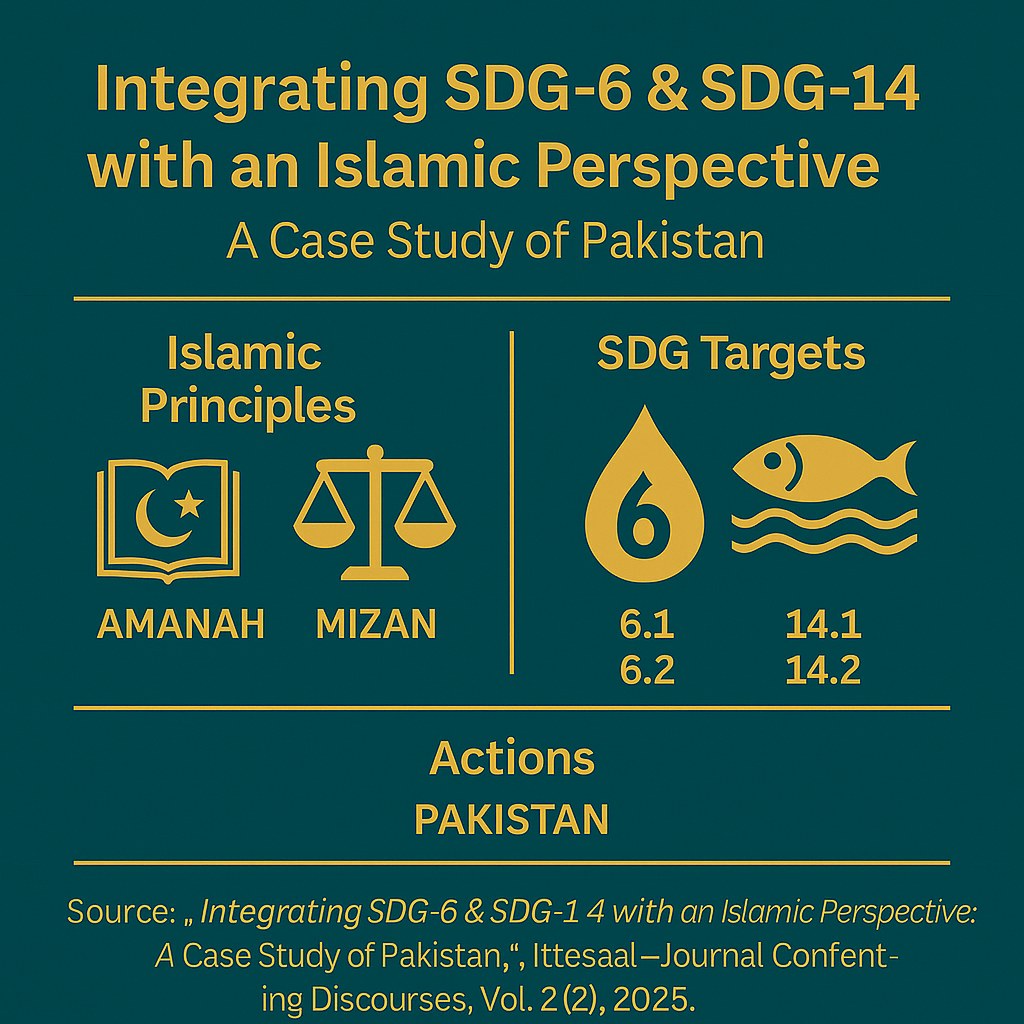
Human life, fertility, cleanliness and purity all depends on water. Water is used for domestic purposes; and in agriculture and industrial sector. The United Nations adopted SDGs in 2015 (Transforming Our World: the 2030 Agenda for Sustainable Development), with an aim to eradicate injustice, lack of sanitation, poverty, inequalities, hunger, global environmental crisis and economic crisis by 2030. The 17 Sustainable Developmental Goals (SDGs) model provides a blue print for a better world. Pakistan was among the nations who readily adopted this plan and aligned it with their vision 2025. SDG-6 (clean water and sanitation) and SDG-14 (life below water) are goals designed to protect the environment from depleting water resources. The current study aims to highlight that human survival depends on ecological balance. Our study will be based on qualitative textual methodology extracting and analyzing as to how SDGs from an Islamic outlook reflects on these principles; and how they coincide with the ethical considerations mentioned in the Qur’an and Sunnah. The purpose of this paper is to explore how Islamic values compliments SDG-6 and SDG-14 by providing spiritual foundation for environmental sustainability. The study also enumerates opportunities and challenges in Pakistan to implement the policies. After introduction our paper will focus on brief explanation of SDG-6 and SDG-14 goals. Later on, we will align these goals with Islamic perspective. Subsequently we will discuss efforts and challenges that Pakistan face to achieve these goals followed by conclusive remarks.
Downloads
References
Aburounia, Hamida Milad., and M. Sexton. "Islam and Sustainable Development." The 6th International Postgraduate Research Conference in the Built and Human Environment. 757-764. Salford: University of Salford, 2022.
"Action for People and Planet: United Nations High Level Week." SDG Summit 2019. September 21-27, 2019. https://sustainabledevelopment.un.org/content/documents/24711SDG_Summit.pdf (accessed May 23, 2025).
Aouati, Fatima Zohra., and Khaled Obaideen. "Sustainable Development Goal 6 and the Prophetic Guidance on Water: A Hadīth-Based Framework." Journal of Islamic Thought and Civilization 15, no. 02 (2025): 137-56. DOI: https://doi.org/10.32350/jitc.152.08
Ashraf, Muhammad. Importance of Water in the Light of Qur’ān and Sunnah and Ways of its Saving. Pakistan Council of Research in Water Resources (PCRWR), Islamabad: Governmentof Pakistan, 2015.
Azad, Abdul Rasheed. Business Recorder. October 23, 2025. https://www.brecorder.com/news/40388790 (accessed October 29, 2025).
Bakloo, Farooq Ahmad., and Asma. "Islamic Perspectives on Sustainable Development." Pakistan Journal of Humanities and Social Sciences 16, no. 4 (2018): 516-525. DOI: https://doi.org/10.52131/pjhss.2018.0604.0061
Basit, Abdul., Muhammad Adnan Siddique, Salman Bashir, Ehtasham Naseer, and Muhammad Saquib Sarfraz. "Deep Learning-Based Detection of Oil Spills in Pakistan’s Exclusive Economic Zone from January 2017 to December 2023." Remote Sens 16, no. 13 (2024): 2432. DOI: https://doi.org/10.3390/rs16132432
Begum, Shahida., and Ahmed Ali. "Water Scarcity in Pakistan: Analyzing Its Political, Social, And Economic Impacts." Indus Journal of Social Sciences 3, no. 2 (May 2025): 431-440. DOI: https://doi.org/10.59075/ijss.v3i2.1275
Bucaille, Maurice. The Bible, the Qur’ān and Science. Translated by Alastair D. Pannell and Bucaille, Maurice. Islamic Book Service, 2001 (1976).
"Drinking Water Quality in Pakistan: Current Status and Challenges." Pakistan Council of Research in Water Resources (PCRWR). 2021. https://pcrwr.gov.pk/wp-content/uploads/2023/08/Drinking-Water-Quality-in-Pakistan-Current-Status-and-Challenges.pdf (accessed October 15, 2025).
Gulzar, Aadil., Tajamul Islam, Muhammad Anees Khan, and Shiekh Mari. "Environmental Ethics towards Sustainable Development in Islamic Perspective." Ethnobotany Research and Applications, 2021. DOI: https://doi.org/10.32859/era.22.39.1-10
Hasan, Zubair. "Sustainable Development from an Islamic Perspective: Meaning, Implications, and Policy Concerns." Journal of King Abdulaziz University: Islamic Economics 19, no. 1 (2006): 3-18. DOI: https://doi.org/10.4197/islec.19-1.1
Kakar, Barkat Shah. Sustainable Developmental Goals SDGs and Islam:Contextualizing the Sustainable Developmental Goals in the Normative Framework of Islamic Tradition. Development Policy Unit, UNDP Pakistan, Planning and Development Department, Quetta: Government of Balochistan, 2022.
Khattab, Mustafa, trans. The Holy Qur’ān. Brooklyn: Qur’ān.Foundation, 1995.
National Water Conservation Strategy for Pakistan (2023-2027). Policy Document, Ministry of Water Resources, Pakistan Council of Research in Water Resources, Islamabad: Government of Pakistan, 2023.
National Water Policy of Pakistan. National Water Policy, Ministry of water Resources, Lahore: Government of Pakistan, 2018.
Rahman, Khalid. "Realizing Sustainable Development Goals (SDGs): Need for an Indigenous Approach." Policy Perspectives 13, no. 2 (2016): 3-27. DOI: https://doi.org/10.13169/polipers.13.2.0003
Sachs, Jeffery D., Guillaume Lafortune, Grayson Fuller, and Guilherme Iablonovski. Financing Sustainable Development to 2030 and Mid-Century. Sustainable Development Report 2025, Dublin: Dublin University Press, 2025.
Shah, Zia H. "The Miracle of Water and the Miracle of the Qur’ān." The Glorius Qur’ān and Science. May 19, 2023. https://theQur’ān.love/2023/05/19/the-miracle-of-water-and-the-miracle-of-the-Qur’ān/ (accessed April 09, 2025).
"Sustainable Development: The 17 Goals." United Nations: Department of Economic and Social Affairs. 2015. https://sdgs.un.org/goals (accessed April 9, 2025).
"TASMAN SPIRIT, Pakistan, 2003." ITOPF. 2003. https://www.itopf.org/in-action/case-studies/tasman-spirit-pakistan-2003/ (accessed October 28, 2025).
Zeshan, Muhammad. "Water Governance Challenges in Pakistan." Pakistan Accountability Lab. 2025. https://pakistan.accountabilitylab.org/wp-content/uploads/2025/02/Policy-Brief-English-Water-Governance-in-Pakistan.pdf (accessed May 10, 2025).
Published
Issue
Section
License
Copyright (c) 2025 Humaira Ahmad, Khaled Obaideen

This work is licensed under a Creative Commons Attribution 4.0 International License.
This work is licensed under a Creative Commons Attribution 4.0 International License. Authors retain copyright and grant the journal right of first publication with the work simultaneously licensed under a Creative Commons Attribution (CC-BY) 4.0 License that allows others to share the work with an acknowledgement of the work’s authorship and initial publication in this journal.
How to Cite